Trad. c. 1205/06
Prayer before the Crucifix
Prayer. A very short plea for faith, hope, charity, discernment, and the grace to carry out God’s command, traditionally placed before the San Damiano crucifix.
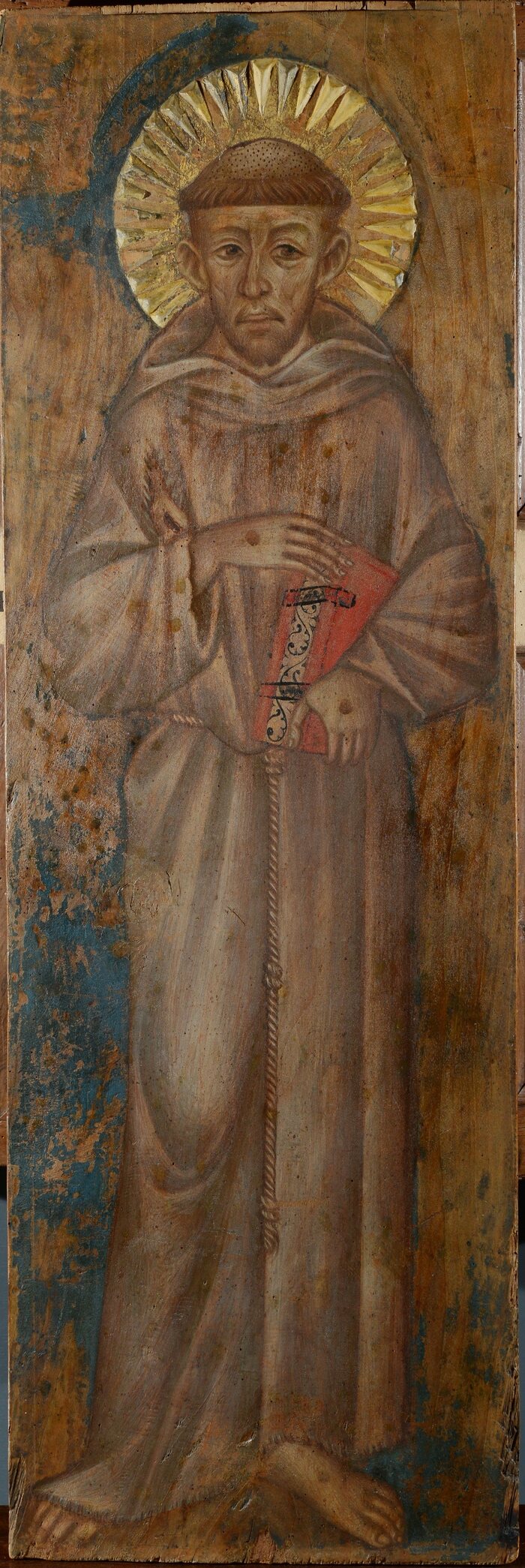
He wanted no one beneath him, nothing possessed, and no road on which Christ could not be met.
Francis was born into a merchant household, dreamed first of knighthood, and was gradually remade by prayer, poverty, the Gospel, ruined churches, and people with leprosy. He called his community the lesser brothers: not a spiritual elite above the world, but brothers moving through it without domination.
He left only a small body of writing—rules, letters, prayers, praises, admonitions, and a testament. That makes the distinction on these pages important: Francis’s own words come first; stories about him are dated and named.
Francis was an author, but not usually a solitary man at a desk. He composed, dictated, revised with brothers, assembled Scripture into prayer, and occasionally wrote in his own hand. Related recensions are kept together below. The dates are a map of likelihood, not a settled publication history.
Prayer. A very short plea for faith, hope, charity, discernment, and the grace to carry out God’s command, traditionally placed before the San Damiano crucifix.
Rule of life. The unsealed, twenty-four-chapter form of the brothers’ Gospel life. It grew from the primitive rule approved orally around 1209 into the community’s working text of 1221.
Brief rule fragment. Francis promises care for Clare’s community and binds its life to the poverty of Christ; the lines survive inside Clare’s later Rule.
Litany of praise. A rough, energetic summons for heaven, earth, and every creature to praise God; its early date is plausible rather than demonstrable.
Practical rule. A compact pattern for three or four brothers: some live as “mothers,” others as “sons,” alternating solitude, prayer, protection, and service.
Twenty-eight teachings. Short instruction on Eucharist, obedience, humility, mercy, peace, purity of heart, and the hidden possession of virtue—probably delivered over time and then collected.
Ecclesial exhortation. Francis urges reverence for the Eucharist and for written words bearing God’s name. The revised form reflects contemporary papal legislation.
Public letter. A warning to civil authorities to remember death, receive the Eucharist rightly, and call their people to public praise of God.
Circular instructions. Francis asks regional superiors to distribute his appeals to clergy and rulers and to foster reverence, proclamation, and prayer.
Letters to the Faithful. A Gospel pattern for lay penitents: love God and neighbor, receive Christ sacramentally, practice mercy, and turn from the self-enclosed life. Their sequence and dating remain debated.
Liturgical praise. Biblical acclamations arranged for communal use before the Divine Office, turning the brothers’ daily hours repeatedly toward worship.
Wisdom poem. Francis greets Wisdom, Poverty, Humility, Charity, Obedience, and Simplicity, then shows how each virtue confounds its opposing vice.
Marian praise. A compact meditation on Mary as virgin, palace, tabernacle, house, robe, servant, and mother of the incarnate Word.
Meditative paraphrase. The Lord’s Prayer is opened phrase by phrase into contemplation, desire, forgiveness, and obedience.
Personal counsel. To a superior exhausted by difficult brothers, Francis makes repeated mercy—not escape to a hermitage—the place where obedience and love are learned.
Dictated teaching. A winter road, a locked friary door, and rejection become Francis’s test: joy lies neither in success nor wonders but in patient, unretaliating love.
Devotional office. Fifteen psalms composed chiefly from biblical phrases let Francis pray in the voice of Christ through Passion, resurrection, ascension, and the feasts.
Papal rule. The distilled twelve-chapter Rule of the Friars Minor, confirmed by Honorius III on 29 November 1223: Gospel, poverty, prayer, work, mission, and life together.
Permission to teach. Francis welcomes Anthony’s teaching of theology so long as study does not extinguish “the spirit of prayer and devotion.”
Circular letter. A solemn appeal to the whole fraternity concerning Eucharistic reverence, the Divine Office, obedience, and the responsibilities of priests.
Autograph prayer. Written for Brother Leo after La Verna: a cascade of names addressed to God—goodness, love, beauty, security, quietude, and refreshment.
Autograph blessing. On the reverse of the Praises, Francis writes the priestly blessing of Numbers 6 over Leo and marks the parchment with the Tau.
Autograph note. Francis gathers counsel spoken “on the way,” releases Leo to discern what best pleases God, and promises welcome whenever he needs to come.
Umbrian song. Sun, moon, wind, water, fire, earth, forgiveness, suffering, and death become siblings in praise. Tradition remembers it growing in stages during Francis’s illness.
Umbrian song. The newly recovered Audite, poverelle consoles and instructs Clare’s sisters in illness, humility, discernment, and life together.
Dictated farewell. Too ill to speak at length, Francis condenses his desire into three charges: mutual love, poverty, and fidelity to the Church.
Remembrance and exhortation. Francis narrates how God led him among people with leprosy, gave him brothers, and revealed the Gospel form of life, then asks that the Rule be observed simply.
Final counsel. Preserved in Clare’s Rule, Francis urges the sisters to remain always in the life and poverty of Jesus Christ and his mother.
Carry little. Enter with peace. Receive what is given. Cross borders without conquest. Find your quietude in God.
What the earliest biography says, what Chesterton imagined, and how hidden prayer opened Francis into dependence, gratitude, and a world received as gift.