Garden-city
Creation restored
This earth becomes fertile, peaceful, embodied, and incorruptible. It protects the goodness of matter and the identity of the Creator with the Redeemer.
What Christians have imagined when they imagined the world made new
historical study · no timetable“Behold, I am making all things new.”Revelation 21:5 · WEB
What would the fulfilled Kingdom actually be like? The imagination reaches for a landscape. Is it this earth repaired, a second earth made after this one is burned, a city in another dimension, a civilization without death, a state of consciousness, the direct sight of God, or a history in which justice at last governs public life? The New Testament gives realities to hope for, but it does not give the physics by which they arrive.
Across Christian history, readers have filled that open space very differently. Some planted vineyards on a renovated earth. Some saw the thousand years in the Church’s present life. Monks found the first air of resurrection inside a heart freed from its passions. Medieval theologians imagined transparent earth and motionless stars. Reformers rejected an earthly Christian regime; other Christians tried to build New Jerusalem by force. Enslaved and newly emancipated people heard Jubilee and resurrection inside political freedom. Modern futurists built sequences; modern theologians recovered new creation as the horizon of ecological and social responsibility.
This is therefore not a catalogue of predictions. It is a history of Christian imagination: what each picture sees, what it protects, and what it is tempted to forget.
Revelation is an apocalypse—an unveiling mediated through vision, angel, symbol, number, and scriptural echo. Its city is also a bride; it is a perfect cube like the Holy of Holies; the Lamb is its lamp; a single tree stands on both banks of a river. Calling this “not precisely correct but not wrong” still measures it as though John attempted a photograph and missed. A better distinction is: the vision may be exact as symbol without being an engineering specification. It tells the truth that Babylon falls, creation is healed, the nations enter the light, death ends, and God dwells with humanity. It does not tell us the chemistry of imperishable bodies or the astronomy of a world needing no lamp. Revelation itself calls what John receives things he “saw”; the genre asks us to see through the images, not around them. USCCB introduction ↗ Yale guide ↗
God says, “I am making all things new,” not merely “I am making all new things.” Romans 8 pictures creation itself released from decay.
Death, curse, mourning, predation, exclusion, and the sea as chaos do not survive. “New” cannot mean the present order with cosmetic repairs.
The Christian hope is resurrection, not the permanent abandonment of the body. Paul waits for “the redemption of our body.”
New Jerusalem comes down. The final movement is not humanity escaping earth but God’s dwelling joining humanity’s.
The new earth is where righteousness dwells. Judgment is not decorative scenery; victims’ tears are wiped away because death-dealing powers are ended.
The center is neither architecture nor endless duration. It is God with them—unmediated presence described as city, marriage, light, and face-to-face sight.
Isaiah still has building, planting, childbirth, long life, and death; Revelation has no death. The later vision receives and transforms the earlier one. Scripture itself teaches readers to expect faithful transfiguration rather than flat replication.
This earth becomes fertile, peaceful, embodied, and incorruptible. It protects the goodness of matter and the identity of the Creator with the Redeemer.
God’s reign begins wherever passion, violence, and falsehood cease to rule. It protects the Kingdom from becoming mere future spectacle.
The world is not just repaired but made transparent to divine glory; divided realities are gathered into communion without ceasing to be created.
Before the final end, the gospel flourishes through a historical season of justice, knowledge, or spiritual maturity. It can inspire reform—or sacralize a program.
Return, tribulation, resurrection, millennium, judgment, and new creation are arranged into an ordered series. It gives narrative clarity, but its precision often comes from a system joining texts that do not themselves appear as one timetable.
Pictures do more than decorate an interpretation. Their materials and visual habits decide what can be seen: mosaic turns the sanctuary into a city; manuscript makes the city a sign; oil paint makes paradise botanically familiar; engraving creates sublime distance; a chart turns apocalypse into ordered information; a photograph makes the present planet itself look newly precious. These works do not form a smooth evolution, and none speaks for every Christian of its century. Together they show the center of imaginative gravity moving—and repeatedly moving back.
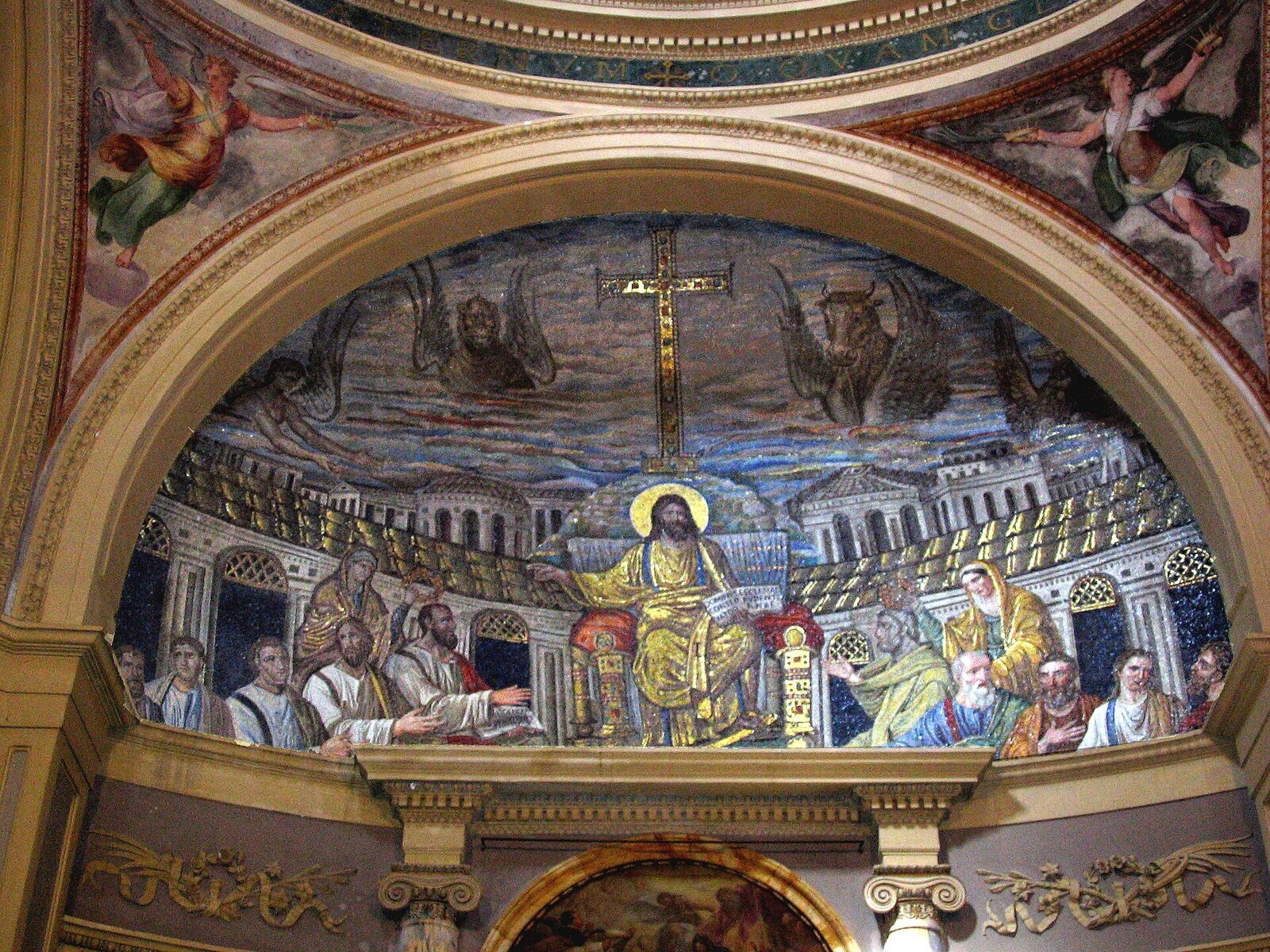
Christ appears enthroned among apostles, clothed in the public visual authority of late Rome. Behind them is Jerusalem in recognizable stone and gold; above it stand the jeweled cross and Revelation’s living creatures. Worshippers did not look through a window into an unrelated elsewhere. The church’s own apse became the place where heavenly rule pressed into earthly assembly.
The shift: an apocalypse born under empire now borrows imperial and civic form to proclaim a different Lord. The gain is public, cosmic confidence; the permanent danger is making Christ’s Kingdom look too much like the empire whose forms carry it.
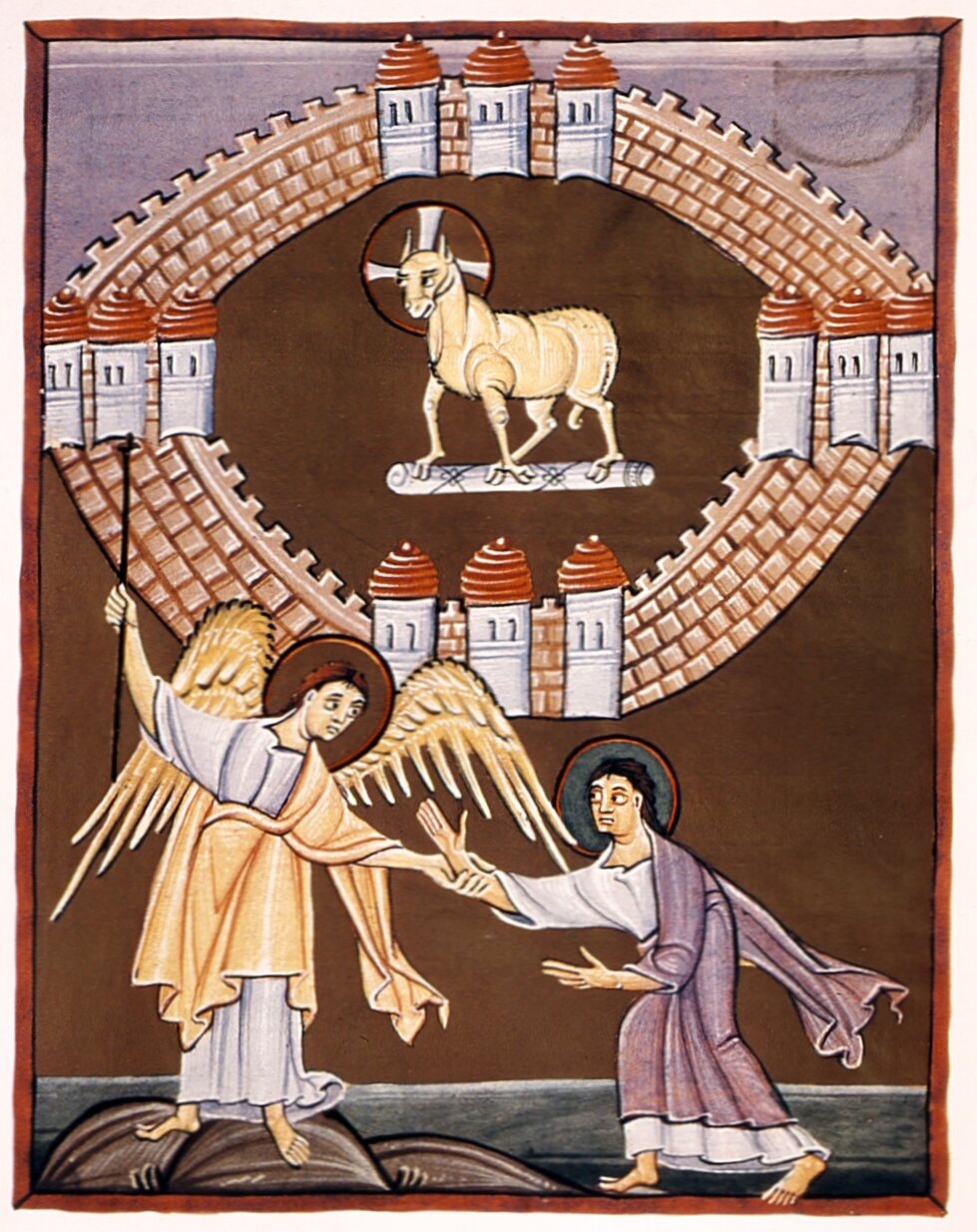
The angel takes John by the hand toward a walled circle. Towers repeat around its circumference; the Lamb stands alone at the center. There is almost no urban life to inspect. Geometry says what perspective does not: all gates lead inward, the center is not a palace but the Lamb, and the city’s meaning is communion around him.
The shift: compared with Santa Pudenziana’s inhabitable architecture, the Ottonian manuscript compresses New Jerusalem into a contemplative diagram. It is less a place one could build than an ordered reality one must learn to read.
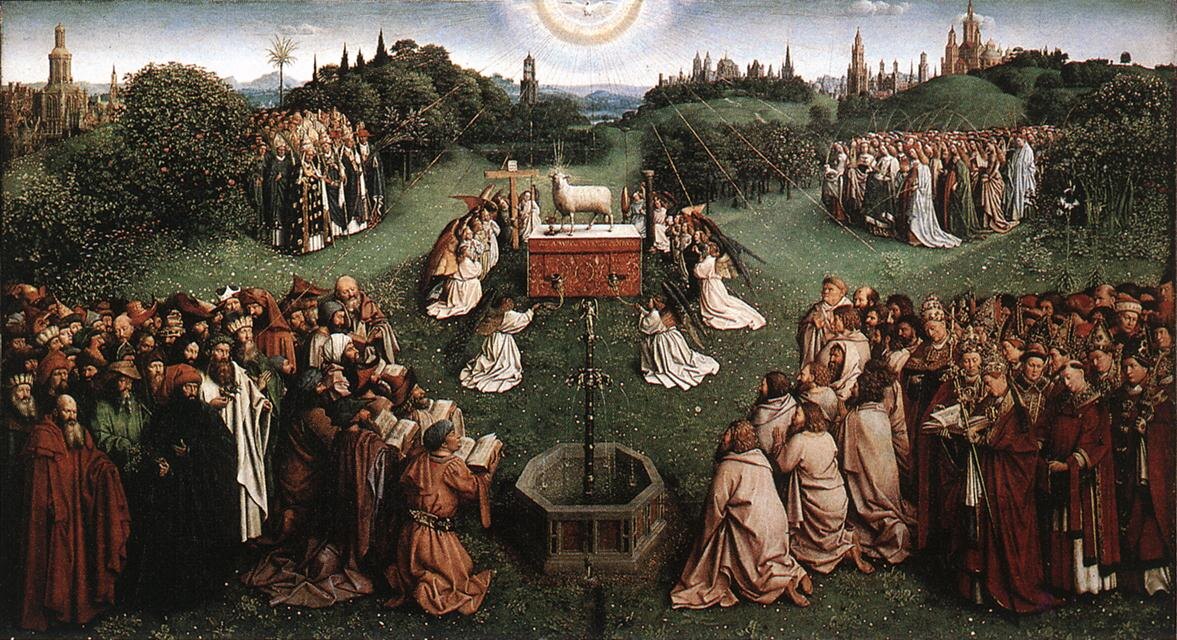
Hubert and Jan van Eyck gather prophets, apostles, martyrs, clergy, and nations through a continuous green landscape toward the Lamb and the fountain of life. Distant towers suggest New Jerusalem. Plants, cloth, faces, water, and light are rendered with intense particularity, yet the light casts no ordinary shadow: recognizable creation is made transparent to another source.
The shift: late-medieval heaven is not only a jeweled destination after death. In an altarpiece above the Eucharistic altar, it becomes renewed earth, sacramental feast, living garden, and worldwide assembly at once.
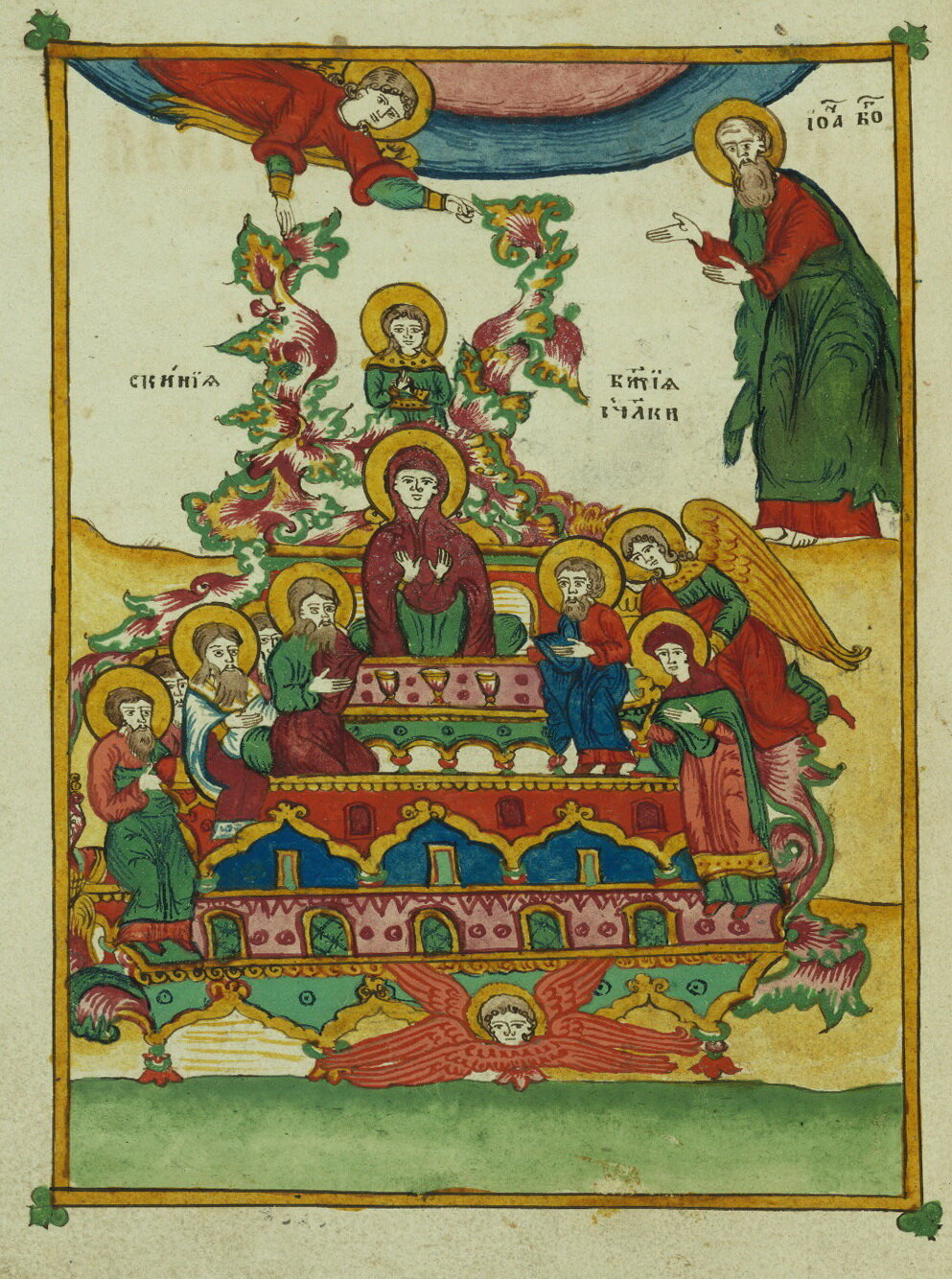
An anonymous Old Believer illustrates Revelation alongside the patristic commentary of Andrew of Caesarea. New Jerusalem is not rendered as masonry but personified as the crowned bride, radiant within a mandorla while John and the angel behold her. The visionary symbol is allowed to change identity on the page just as it does in Revelation itself.
The shift: this image complicates any tidy Western story from manuscript to print. A persecuted community, often denied presses and vulnerable to confiscation, kept hand-copying apocalypse. Older visual time survived inside modernity as resistance and memory.
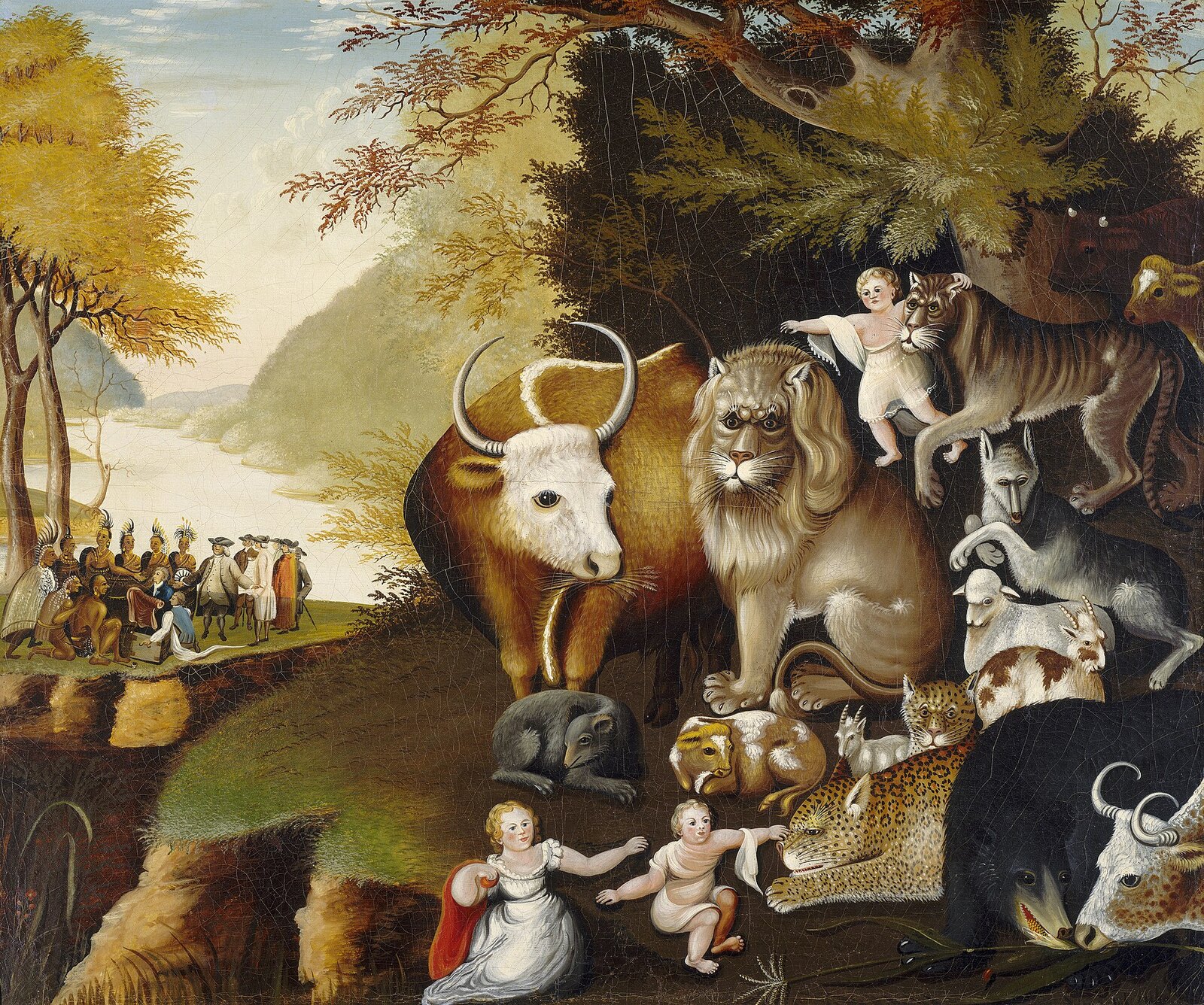
The Quaker minister Edward Hicks painted the peaceable kingdom again and again. Isaiah’s children and reconciled animals dominate this version; at left, William Penn’s treaty with Lenape people is made a political echo of the prophecy. The future Kingdom becomes a criticism of violence and a possibility to be practiced in public history.
The shift: paradise moves from church and celestial city into an American landscape and an ethic of peace. But the treaty vignette is also an idealized settler memory. It shows how easily a community can paint its own contested history as the Kingdom’s advance.
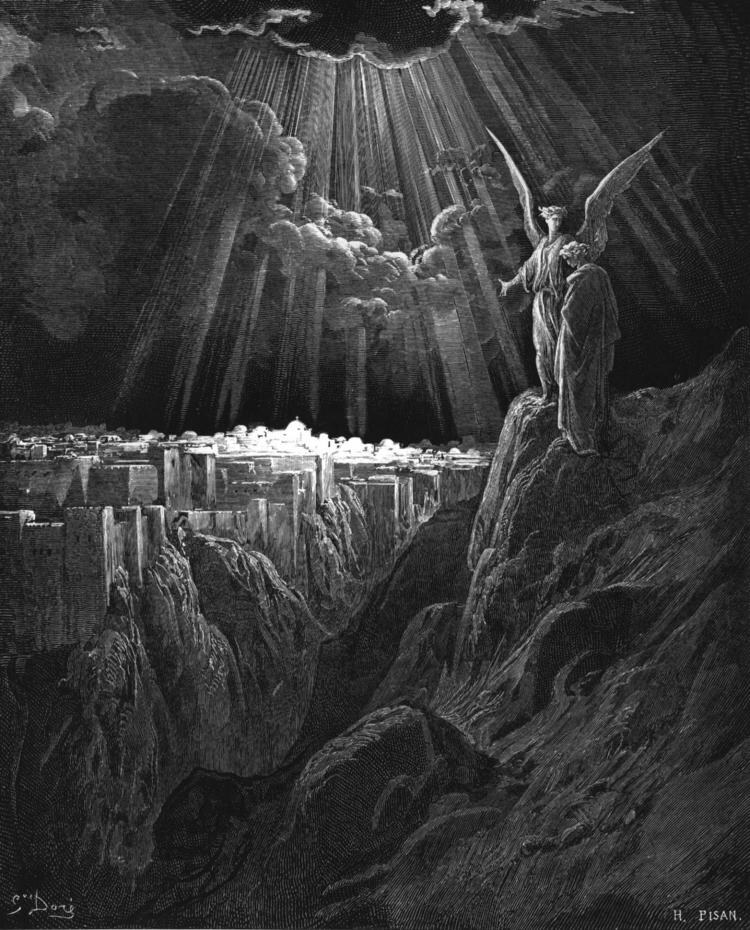
Gustave Doré gives John and the angel a precipice from which to view a radiant metropolis across an abyss. The light is overwhelming, the scale superhuman, and the city visibly elsewhere. Mass-reproduced in illustrated Bibles, this is the sort of image that can silently teach readers what “heaven” looks like even before interpretation begins.
The shift: the engraving restores drama and depth but increases distance. Revelation says the city descends; Doré’s visual rhetoric makes the viewer travel imaginatively away from the present earth toward an unreachable celestial civilization.
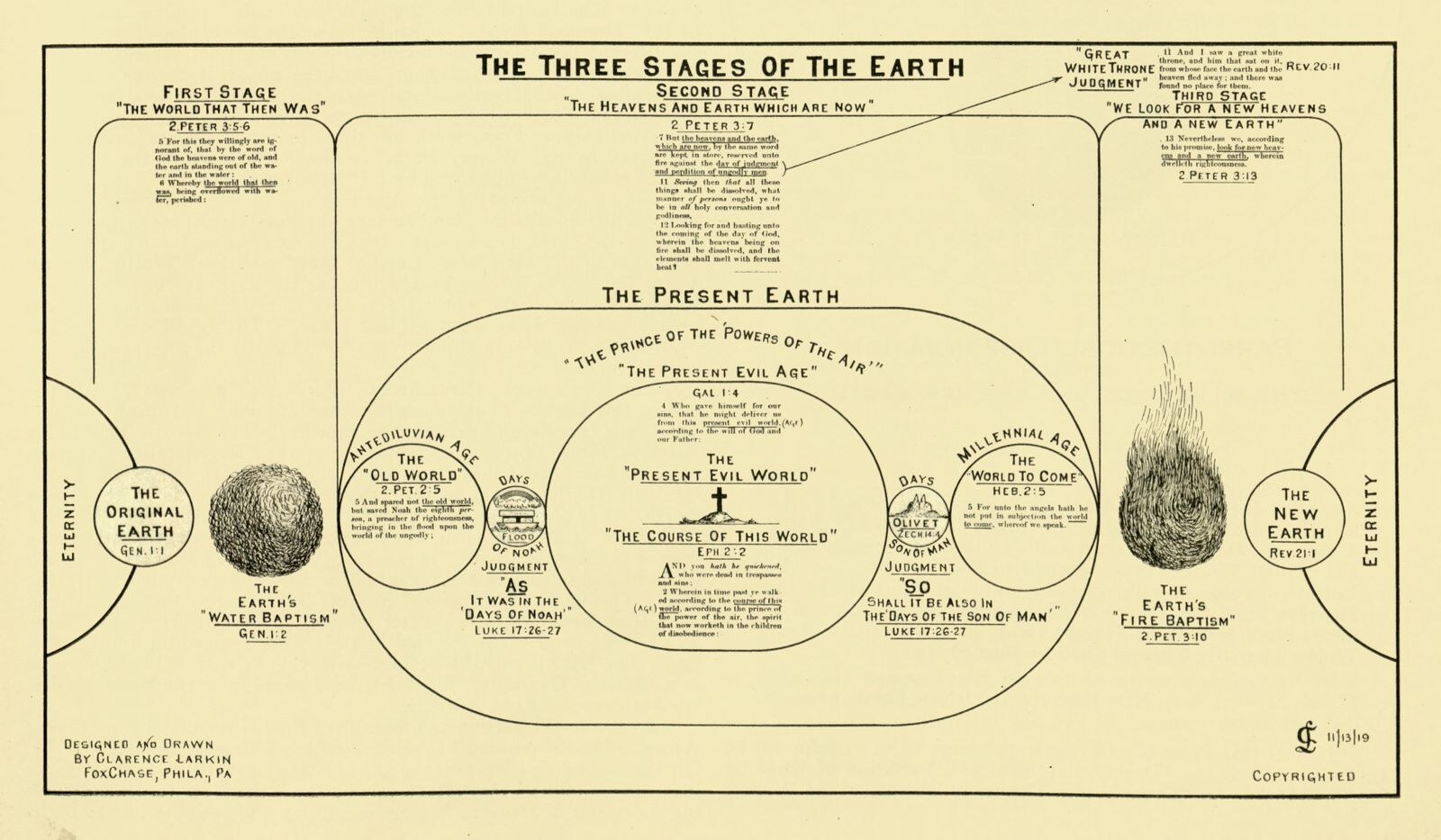
Clarence Larkin, trained as a mechanical draftsman, arranges the original earth, Flood, present evil age, millennial earth, fiery judgment, and new earth across one controlled visual system. Arcs, labels, arrows, nested ages, and proof-texts do something radically different from the mosaic or illumination: they imply that the reader can see the entire sequence simultaneously from above.
The shift: the industrial age turns apocalypse into a technical drawing. The gain is teachable clarity and chronological distinction. The cost is that symbol begins to look like mechanism, and one modern synthesis can appear to be the Bible’s own diagram. Open the plate to read it at full size.
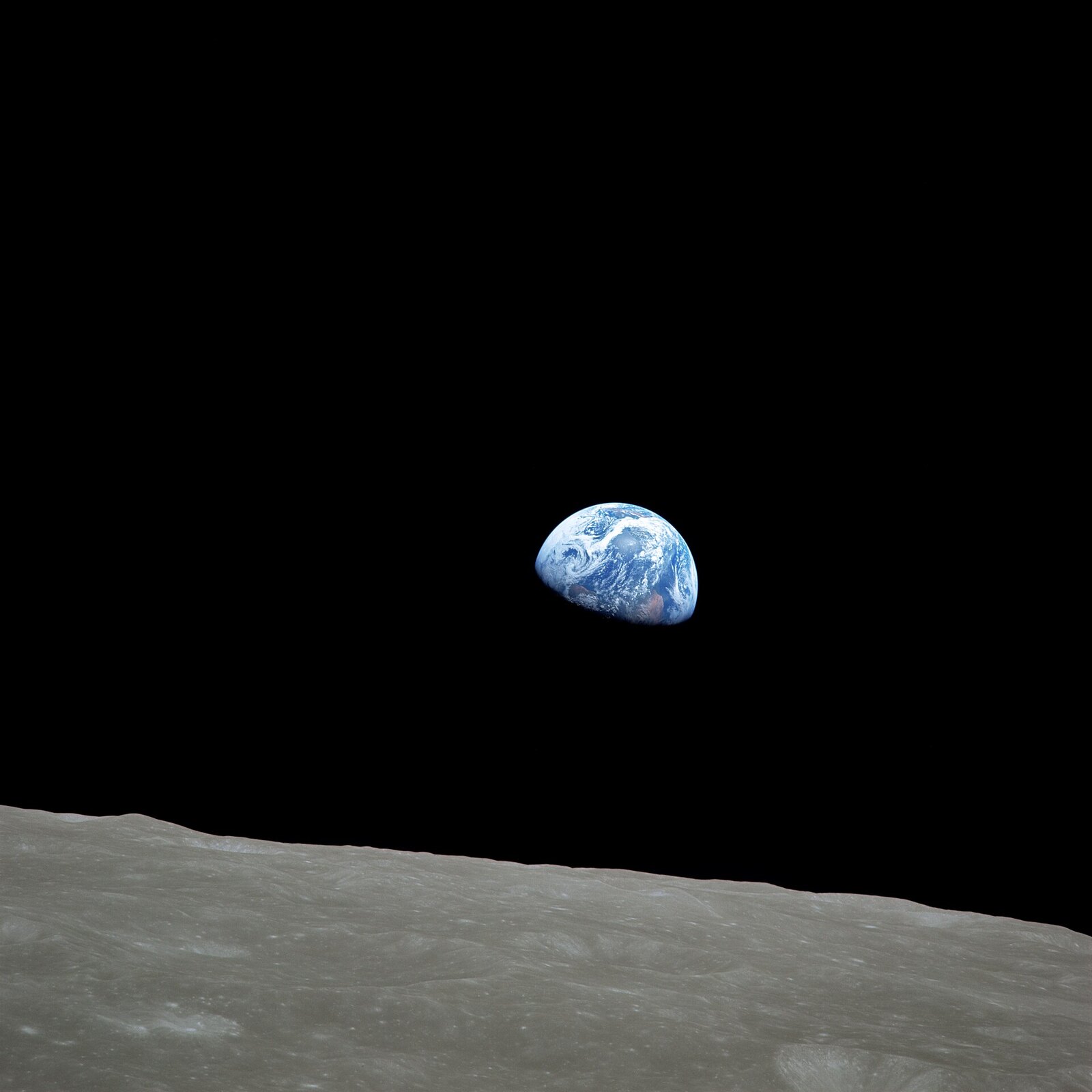
Earthrise is not Christian art and does not depict the End. It belongs here because it altered the imaginable world in which Christians read “new earth.” For the first time, ordinary people saw their whole home as one luminous, borderless, fragile body against darkness. NASA and Library of Congress histories connect the photograph with the emerging ecological consciousness.
The shift: late-modern imagination gains a planetary object worthy of grief, care, and promised renewal. New-creation theology increasingly speaks of ecosystems and the common creaturely home. The photograph proves no doctrine; it changes what “this creation” can look like to hope.
The dominant place moves from sanctuary and holy city, to a world beyond an abyss, back into reconciled land and society, and finally to the whole visible planet. Descent and escape keep pulling against each other.
Early images proclaim who reigns; medieval images order worship and contemplation; modern images press moral reform, explain a sequence, or awaken care for creation.
Mosaic and icon make the vision present in worship. Painting makes it optically familiar. Engraving makes it spectacular. The chart makes it systematic. Photography makes the present world newly strange.
Every age alternates between symbol and blueprint, present participation and future intervention, interior transformation and public order. New media change the balance; they do not settle the texts.
The history is a pendulum, not a ladder. Christians do not steadily progress from a primitive picture to a correct modern one. Older modes coexist and return. What changes most is the question placed at the center: Who truly rules? Where do the blessed go? What would peace look like here? What happens next? Can this wounded planet have a future?
Against movements that treated matter as a botched product of an inferior maker, Irenaeus would not let salvation leap over the body or the earth. The risen just behold God “in this creation which is renovated.” He preserves an older saying attributed through Papias: vines and grain become fantastically fecund, and animals return to peace. The numbers are exuberant, not agronomy. The point is that creation ceases to resist life.
“It is fitting, therefore, that the creation itself, being restored to its primeval condition, should without restraint be under the dominion of the righteous.”
Irenaeus · Against Heresies V.32.1
This is the tradition’s most tactile early answer: not souls evacuated to a remote heaven, but bodies, meals, land, animals, and the promises to Abraham brought into incorruption. primary text ↗
Origen objects to Christians who read precious stones, banquets, marriage, and vineyards as guarantees of inexhaustible bodily appetite. He does not simply erase embodiment: elsewhere in the same work he wrestles with whether rational creatures can ever exist without bodies. But he makes the coming age an unending education in divine reality, where scriptural goods name intellectual and spiritual nourishment.
His correction permanently widened Christian imagination: resurrection life cannot be a perfected version of acquisitive life. His larger speculations about the restoration of rational beings later became deeply contested; that controversy should not be smuggled into this narrower point. De Principiis II.11 ↗
The early Egyptian monks left no common diagram of the End. Their characteristic question was not What objects will be there? but What in me could live there? Yet this was not a denial of future resurrection. Their interior Kingdom was a pledge and practice of the one still to come.
Athanasius’ Antony tells monks to live as though dying daily
. Daily remembrance of death loosens wealth, lust, anger, and resentment; at his own death he insists his body be buried, treating the body as a body awaiting resurrection rather than a relic to be displayed. The End becomes an ethical present tense. Life 19, 89–91 ↗
Evagrius opens the Praktikos with two astonishing definitions: the kingdom of heaven is dispassion of the soul, together with true knowledge of beings
; the Kingdom of God is knowledge of the Holy Trinity
. Apatheia here is not numbness but freedom from compulsions that distort love and perception. Paradise is creation finally seen truthfully and God known as God. Praktikos 2–3 ↗
Cassian transmits Egyptian teaching to the Latin West and refuses an either/or. The Kingdom is founded within when sin no longer reigns; it is righteousness, peace, and joy in the Spirit; it is also the saints’ reign, Christ’s rule over all things, and the future city where sorrow flees. Interior transformation, ecclesial life, and cosmic fulfillment are three depths of one reality. Conference I.13 ↗
Ephrem the Syrian’s Hymns on Paradise treats Eden as a mountain encircling creation, with fragrance, fruit, light, and ascending levels. The architecture is symbolic pedagogy: visible nature becomes a mirror in which the mind learns to perceive invisible mercy. Paradise remains corporeal without being reducible to present physicality.
Three centuries later Isaac of Nineveh is still more explicit. Biblical promises use beloved, delightful names to awaken desire, while the things to come are not identical with present sensible goods. The pledge must resemble the fulfillment: when a person finds love now, Isaac says, that person already “breathes … the air of resurrection.” The feast Jesus promises is finally love itself—not less real than bread, but the reality bread was teaching. Isaac, Homily XLIII ↗
Augustine’s reading became decisive in the medieval West. The thousand years signify the whole present age of the Church; the “first resurrection” is the passage from the death of sin into new life. That removes a separate earthly millennium after Christ’s return. It does not turn the final hope into a metaphor for church history: tears and death remain, so Revelation 21 cannot yet be fulfilled.
“This world shall pass away by transmutation, not by absolute destruction. … The figure, therefore, passes away, not the nature.”
Augustine · City of God XX.14
The city already descends by grace as citizens are formed; at judgment its glory becomes complete, including incorruptible bodies and a transfigured world. Present and future overlap without collapsing. City of God XX ↗
Maximus the Confessor offers something closer to theological cosmic fiction than almost any earlier writer, though he means metaphysics, not machinery. Creation is divided: uncreated and created, intelligible and sensible, heaven and earth, paradise and the inhabited world, male and female. Humanity was made as a bond capable of joining the divided creation to God through love; humanity failed, and Christ completes that vocation.
In Christ, paradise and the inhabited world become one earth; heaven and earth, sensory and noetic reality are held together; the war within beings ends in “peaceful friendship and undivided concord.” The creature does not become God by nature, but is wholly pervaded by divine grace. The Kingdom is not a new location so much as the cosmos’s broken relations healed without the cosmos ceasing to be creation. Ambiguum 41 ↗
Joachim read the patterns of Scripture as overlapping status: Father, Son, and Holy Spirit. He expected, after severe crisis, a contemplative Sabbath of freedom and spiritual understanding before the end. Modern shorthand often calls him a millennialist, but the label is too flat: his third status grows organically from the first two, and his several schemes do not form one clean chart.
His enormous legacy was the possibility of a qualitatively new age inside history. That hope fed spiritual reform; detached from Joachim’s qualifications, it also licensed later groups to identify themselves as history’s final vanguard. Marjorie Reeves study ↗
The posthumously compiled Supplement to Thomas Aquinas’s Summa, drawn from his earlier commentary, asks whether stars move, whether elements shine, and whether plants and animals remain. Its answer imagines earth bright like glass, water like crystal, transparent air, motionless heavens, and no surviving plants or animals. The confidence is startling—and useful as a warning that every age accidentally dresses eternity in its own cosmology. Supplement, q. 91 ↗
Dante’s Paradiso travels through that medieval cosmos only to discover that the blessed were never spatially parceled among planets. The spheres accommodate Dante’s sight. At the limit of speech, fulfillment is the human desire and will turning in harmony with “the Love that moves the sun and all the other stars.” Julian of Norwich compresses the same confidence into something the size of a hazelnut: all that is made, small and fragile, lasts because God loves it. Neither is a systematic account of new earth; both insist that the final world is best imagined as creation perfectly held in love. Dante, Paradiso XXXIII ↗ Julian, Revelation 1 ↗
The Augsburg Confession states the common magisterial Protestant rejection of a pre-resurrection world kingdom possessed by the godly. The fear was not abstract. In 1534–35 a radical apocalyptic faction took Münster, called it New Jerusalem, expelled or coerced opponents, and developed into a violent theocratic monarchy under siege.
Münster must not be made a definition of Anabaptism: nonviolent Anabaptists survived partly by repudiating it. Its lasting lesson is broader. Once a group identifies its rule, leader, city, or nation with the final Kingdom, ordinary disagreement becomes rebellion against God and violence becomes purgation. Augsburg XVII ↗ Oxford history ↗
John Bunyan’s dream gave generations an unforgettable map: Christian leaves the City of Destruction, crosses a river without a bridge, and enters the Celestial City. It is allegory of the soul’s pilgrimage and death, not a technical denial of final resurrection. Still, its emotional geography—leave this world for the city above—helped “going to heaven” dominate popular imagination more readily than a city coming down. Pilgrim’s Progress ↗
Jonathan Edwards looked the other direction. He expected an extraordinary historical period after Antichrist’s fall: knowledge, holiness, peace, and worldwide gospel flourishing, the “principal time of the kingdom of heaven upon earth.” This was not yet the eternal state. It was a postmillennial confidence that history itself could become luminous before the final resurrection. History of Redemption ↗
White accounts often sort hope into “literal future” or “mere metaphor.” Black Christian life after emancipation breaks that grid. Historian Matthew Harper shows that four million emancipated people could understand 1865 simultaneously as divine intervention, resurrection, Jubilee, and a sign of the end days. “Zion,” “dry bones,” and “New Jerusalem” appeared in Black political writing because choices about work, migration, land, and citizenship now occupied sacred time.
This was neither the claim that death had ended nor a spiritualization of freedom. An eschatological event could be genuinely fulfilled and still demand a fuller fulfillment. Hope gave historical agency to people whom slaveholding Christianity had told to postpone freedom until heaven. The End of Days ↗
John Nelson Darby developed the system later called dispensationalism; C. I. Scofield placed a version of it into the notes of an enormously influential study Bible. Prophetic texts from Daniel, the Gospels, Paul, and Revelation became one itinerary: a distinct Church age, removal of the Church, tribulation, Christ’s return, defeat of the Beast, judgment of nations, a literal thousand-year kingdom, final revolt, judgment, and new creation.
Scofield’s notes are a revealing historical artifact: Revelation 19 receives a numbered order of events, while the New Jerusalem belongs after the thousand years. This is the ancestor of much modern apocalyptic film and fiction. Its imaginative power comes from narrative continuity and apparent legibility; its vulnerability is that readers can forget which links are stated by a passage and which are supplied by the system. Scofield notes, 1917 ↗ Oxford history of Darby ↗
Seventh-day Adventist teaching places the redeemed with Christ in heaven during the millennium while the earth lies without living human inhabitants. At its close, Christ, the saints, and the Holy City descend; evil is finally ended and the earth becomes the eternal home of the redeemed. Its official description notably includes everlasting “life, love, joy, and learning”—an eternity with discovery rather than static repose.
This differs both from Augustine’s present millennium and dispensationalism’s millennium on a populated earth. It shows how the same chapters can generate quite different cinematic sequences even among readers committed to futurity. Fundamental Beliefs 27–28 ↗
In a seminary paper, the twenty-one-year-old King called a physical return incompatible with a modern cosmos and sought the doctrines’ “spiritual pertinence.” The Kingdom arrives wherever human relations are controlled by trust, mercy, unselfish service, and divine love. The spectacular scene becomes an ethical judgment on the present.
This source must be labeled carefully: it is an early student paper, dependent on assigned modern theologians, not a final systematic creed for King’s mature ministry. But it records one historically powerful answer to modernity: do not discard apocalypse; translate its world into the Beloved Community. Its gain is moral urgency. Its risk is losing the stubborn biblical claim that God does what human progress cannot—raise the dead and end death. King Institute transcript ↗
Jürgen Moltmann’s theology of hope made resurrection and new creation the horizon of every doctrine, not a final appendix. The world is unfinished; present creatures can be seen as promises of their own future in God’s glory. Hope contradicts death and makes present arrangements provisional. It therefore presses toward ecological care and social change rather than escape. Moltmann, The Hope of the Earth ↗
Gustavo Gutiérrez similarly refused to make salvation and liberation rivals. Historical acts of liberation can be partial fulfillments of eschatological promise, yet none is the Kingdom’s full realization. The final gift remains God’s, which both authorizes struggle against oppression and denies every revolution permission to call itself the End. St Andrews overview ↗
An Orthodox Church in America catechetical text says salvation is not flight to an “other world” but this world resurrected and glorified, never annihilated into a second creation. The Catholic Catechism calls it a mysterious transformation of humanity and the world and repeats Vatican II’s confession: We know neither the moment … nor the way in which the universe will be transformed.
The global evangelical Cape Town Commitment centers bodily resurrection, reconciliation of all creation, the end of violence, and God dwelling with humanity.
This is not consensus about the millennium, Israel, judgment, hell, or the events surrounding Christ’s return. It is a deeper convergence about the destination: not the victory of disembodied souls over creation, but the victory of God’s faithful love for creation. And all three make that future morally present—in worship, mission, justice, peace, and care for the world that is promised a future. Orthodox Faith ↗ Catechism 1042–50 ↗ Cape Town Commitment ↗
Science fiction is not a bad reflex. It notices that bodily, cosmic hope invites questions about matter, identity, time, place, work, culture, and discovery. The historical tradition gives real precedents for that curiosity. It also shows where curiosity becomes false certainty.
| Question | What Christians have imagined | What can honestly be said |
|---|---|---|
| Is it this universe? | Irenaeus, Augustine, Maximus, modern Orthodox teaching, and Romans 8 favor continuity through radical transformation. | Strongly grounded; mechanism unrevealed. |
| What are bodies like? | Continuous in identity, incorruptible, no longer mastered by death; patristic writers imagine perception liberated from decay. | Resurrection is given; its biology is not. |
| Will there be animals? | Irenaeus says peaceful animals; the medieval Summa Supplement says none; modern creation theology often hopes for creaturely participation. | Romans 8 is cosmic; individual animal survival is unsettled. |
| Will there be cities and culture? | Revelation retains a city, nations, kings, gates, and the nations’ “glory and honor.” Vatican II expects the good fruits of human endeavor transfigured. | Cultural continuity is suggestive, not inventoried. |
| Will we work and learn? | Isaiah builds and plants; Adventists name eternal learning; Maximus imagines unending participation in God rather than inert rest. | Meaningful life, yes; careers and technologies, unknown. |
| Will time or stars continue? | Medieval scholastics stopped celestial motion. Modern cosmology makes that picture obsolete, but supplies no replacement doctrine. | Endless life is promised; the metric of time is not. |
| Other planets? Travel? Technology? | Older writers had other cosmologies and do not answer our interstellar questions. Nothing requires an eternally small imagination. | Possible to imagine; impossible to teach as revealed. |
| Will I still be myself? | Bodily resurrection, judgment of deeds, healed memory, recognition, and communion all require personal continuity without preserving every wound as wound. | The person is redeemed, not replaced; the psychology is mystery. |
If a picture makes material existence irrelevant, it has ceased to imagine resurrection and begun to imagine escape.
If a picture explains the machinery, calendar, and geography without remainder, it knows more than the texts disclose.
If “all things new” does not answer tears, violence, exploitation, and graves, it is aesthetic novelty rather than biblical justice.
No human program manufactures resurrection. Historical progress may witness to the Kingdom; it cannot close the distance to the End.
A future that makes this earth disposable contradicts creation’s promised liberation and turns hope into permission for neglect.
Every historical model bears the furniture of its age. A true fulfillment will answer the symbols while exceeding every storyboard.
The tradition’s most durable answer is not a floor plan. It is a pattern: the world is not discarded but delivered; the body is not escaped but raised; difference is not erased but reconciled; justice is not postponed but completed; God is not far away but at home with creation.
The Desert Fathers add the necessary present tense. The life of that world can be inhaled now wherever desire is freed from domination and love becomes food. The liberation traditions add the public tense: if the city’s gates are open and the nations walk in light, hope must oppose the arrangements that make neighbors disposable. The failures of Münster and every national New Jerusalem add the limit: we may witness to the Kingdom, but we may not identify our power with it.
So let the imagination become enormous. Imagine matter without decay, memory without torment, culture without domination, discovery without danger, difference without estrangement, and a universe transparent to love. Then write speculation in the margin. What is promised is stranger and firmer than the picture: resurrection, righteousness, communion, and God all in all.
USCCB notes on apocalyptic genre, Old Testament imagery, Rome, and first-century resistance.
The basilica’s guide to the apocalyptic, Roman-imperial, and heavenly-Jerusalem imagery.
Official description and shelfmark of the Reichenau manuscript and its fifty miniatures.
The continuous heavenly landscape, Eucharistic Lamb, fountain, liturgy, and new realism.
Provenance and rights for the Old Believer New Jerusalem-as-bride miniature.
Museum record for the Isaiah 11 landscape and Penn treaty vignette.
Archival scan and metadata for Clarence Larkin’s 1919 prophetic chart.
Earthrise and its place in the emergence of ecological imagination.
Renovated creation, bodily resurrection, Papias’s abundance, earthly kingdom.
Critique of sensual literalism and the promises as education in divine wisdom.
Daily death, judgment, discipline, bodily burial, and resurrection.
Kingdom as dispassion, knowledge of beings, and knowledge of the Trinity.
The Kingdom within, three senses of heaven’s reign, and the future city.
A. J. Wensinck’s 1923 translation from Bedjan’s Syriac; love as Kingdom and air of resurrection.
Present millennium, future resurrection, and transmutation rather than annihilation.
The five divisions and their recapitulation in Christ.
Medieval questions about light, celestial motion, elements, plants, and animals.
Italian and English text at the Princeton Dante Project.
Public-domain text of the visions and long meditation.
Resurrection, judgment, and rejection of a pre-resurrection world kingdom.
The City of Destruction, river without a bridge, and Celestial City.
The coming historical prosperity of the Kingdom on earth.
The modern dispensational sequence in its influential early form.
Official statements on the millennium and new earth.
Transcript and archival description of the 1950 seminary paper.
New earth, historical work, mystery, and the transfiguration of earthly goods.
Official catechetical account of this world resurrected and glorified.
Global evangelical statement on bodily resurrection, mission, and new creation.
Historical study of Black eschatology, emancipation, and Reconstruction.
Scholarly correction of simplified accounts of the third status.
Creation as promise of its future in the Kingdom of glory.
Scope. “All historical examples” cannot literally fit on one page: most Christian communities, sermons, hymns, liturgies, political movements, and works of art have imagined the End somehow. These sixteen windows were selected to cover the major recurring forms of the vision and several decisive counterexamples. They are representative, not a claim that one person speaks for an entire century, nation, or communion.
Quotation and summary. Text inside quotation marks was checked against the linked source. Irenaeus, Origen, Athanasius, Cassian, Augustine, Isaac, the medieval Summa Supplement, Bunyan, Edwards, and Scofield are read in public-domain translations. Evagrius is quoted briefly from the linked bilingual edition. Ephrem, Joachim, Dante, Julian, Maximus, Black Reconstruction eschatology, Darby, Moltmann, and Gutiérrez are principally summarized. Modern confessional statements are quoted only briefly and linked in full.
Images. The eight plates are locally stored derivatives of public-domain, Public Domain Mark, or United States government works. Each caption links its holding institution or file page and states the rights basis. The files were resized and JPEG-recompressed without cropping; download URLs, credits, licences, and checksums are recorded in sources/eschatology/vision-plates.json.
Scripture. Biblical wording quoted as Scripture is from the public-domain World English Bible and was checked against the site’s stored text. “Behold, I am making all things new” at Revelation 21:5 is not set in rubric red because the identity of the throne’s speaker at that point is one of the attribution questions the Gospel corpus leaves marked rather than deciding.
Posture. This page distinguishes revealed claims from historical models and speculation. It does not decide the millennium, the mechanics of cosmic renewal, or the scope and nature of final judgment. Its judgment is narrower: no model is adequate if it loses resurrection, justice, creation, communion, or the difference between God’s Kingdom and our power.


